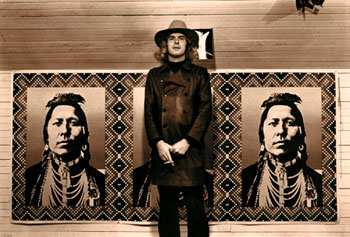
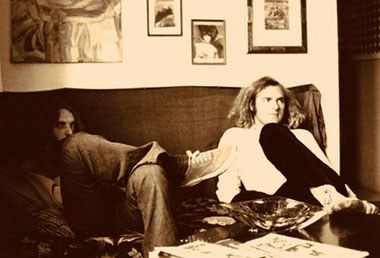
| John Van Hamersveld Kingsley Loft Studio - 1968 © John Van Hamersveld |
|
|
|
|
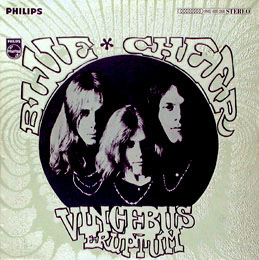
| Introduction: When John Van Hamersveld left the art school scene of the late Beat Era in the early 60's artists were becoming media minded like Andy Warhol & The Factory with the Velvet Underground. Andy was seen in Life Magazine as "the" pop artist. Everyone knew the Beatles' sound in the 60's was the "British Invasion". They were transforming the British bubblegum hits into American Culture as fashion. Their uniform hair cut and suits were the new look. "The Endless Summer" album cover image and soundtrack, distributed by Capitol Records, brought a different surf sound to radio. The film had done 30 million dollars in sales then at the box office as an independent film in America. The popular Beach Boys were on the same label and their sound was a part of the transition of the surf sound in the 60's, during music industry standards, all turns into the psychedelic sound and fashion of the high culture of the new media. In the early 60's the Beatles and Beach Boys dominated the radio and concert venues through America, all was distributed by the Capitol Records Company in the mid 60's, but all changed into the San Francisco enviable new sound of bands like The Dead, Big Brother, The Jefferson Airplane and the Blue Cheer. During the change in the culture, John Van Hamersveld designed album covers, posters and promotions in the art scene of the 60's and 70's, for the likes of The Jefferson Airplane and The Rolling Stones, where he gains his reputation from as an American Artist and Designer. Gut Turk the artist & the "Vincebus Eruptum" album cover:
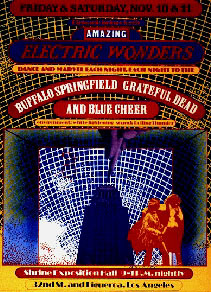
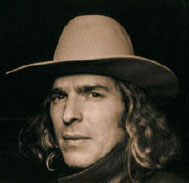
John Van Hamersveld: This part is about meeting Gut Turk the manager of the Blue Cheer band, 1967. I was one of the founders and a part of forming "Pinnacle Rock Concerts", as one of the three partners. I was an art director at Capitol Records since 1966 and had finished the Beatles "Magical Mystery Tour", the front of the Album Cover, released that summer in 1967.ÊFor me, at the time of the first shows, we as a production company had organized a series of Dance Concerts.ÊOn the eve of the first concert, I was introduced to Gut during the days of Pinnacle's "Electric Wonders" show at the Shrine Exposition Hall.ÊThe Blue Cheer was the hit of the weekend party.ÊGut, as the manager of the band, came around after the show and asked if I would take a photo of the band for his new album cover for "Vincebus Eruptum".ÊGut later introduced me to Hell's Angels that would drop by the studio at the time. Gut was the dominate character who represented the image of the Blue Cheer band when we all met in the "Pinnacle" deals. Gut was a great influence as a crazy friend with great stories he told about his life and times in San Francisco, his world he constructed for all of us to understand.
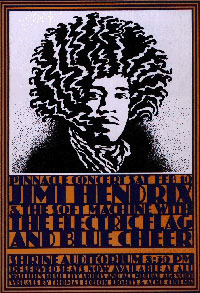
Blue Cheer - Vincebus Eruptum About the Blue Cheer band photograph: John Van Hamersveld: My studio was upstairs in a victorian two storey house, at Coronado and Wilshire, near Otis Art School in Downtown Los Angeles. This is where I had two apartments adjoining one another on the second floor, where it was set-up for making photographs, an art studio for my drawings and posters that became the famous "Hendrix Head".
From an article for background: Designing Images During the Counter Culture of the 60's: Los Angeles, also, boasted a number of influential music venues, mostly in the vicinity of the Sunset Strip. The most popular was the Whisky-a-Go-Go, which soon became not only an important venue for the San Francisco bands, but also a springboard for many of L.A.'s own acts like The Doors, Love and The Byrds.
A serigraph is a color print made by the silk-screen process and printed by the artist. The silk-screen process is a stencil method of printing a flat, color design through a piece of silk or other fine cloth on which all parts of the design not to be printed have been stopped out by an impermeable film. Silk-screening also makes use of a squeegee to force ink directly on to the surface to be printed. Visions of Andy Warhol and Roy Lichtenstein with their huge silk-screened canvasses flash through the mind when the term serigraph is mentioned, since it is this technique that many high priced, upscale art galleries have succeeded in selling their works. It is this same technique that began flourishing through the "Rock" poster underground in the early '90s. Silk-screen printing is most widely known for its use of printing on fabrics and is how the method originated. The first silk-screens were made of fine silk threads and strands of human hair by the Japanese as a way to apply stenciled shapes to fabric.
Pop art and op art revitalized the screen printing process in the early 1960s as an art form rather than just a commercial printing technique. Perhaps, this could have lent itself to the next wave of producing "Rock" show (or "Gig") posters in the mid to late 1960s during the "Psychedelic Era". Previously, most "Rock" posters were a clutter of type with perhaps a photograph of the performer that were either taped to store windows or stapled to telephone poles to advertise the "Gig". The poster soon incorporated illustrations into the design and, as this "Psychedelic Era" began, unusual lettering or logos morphed into illustrations, which blended into a display of mind bending colors.ÊThese posters produced either by serigraphy (screen), lithography (flat), or offset (cylinder) saw pop art tones with day-glow expressionism reflect the cultural clash of society, the Vietnam War and mind expanding drugs becoming a new direction in American art. This new breed of artists, including Rick Griffin, Stanley Mouse, Alton Kelly, Victor Moscoso, Wes Wilson, John Van Hamersveld, Gary Grimsham, Randy Tuten, and others would influence generations to come while helping design the face of "Rock".
But the popular new "Limited" idea started at a store front in Santa Monica, at the Jeff Wasserman Silkscreen Shop, who had worked as a GEMINI printer in 1979. It was the edge of the 1980's. This was now signed serigraphs sales, sold out of upscale galleries, like publisher Mirage Editions, where Van Hamersveld had designed for the Smithsonian and the Cooper Hewitt of the Oceanliner Print, The Cooper Hewitt, the book store. But it was the new L.A. scene called "WET" created by Leonard Corren, the "WET Leg" Poster Limited Edition was distributed like the "Endless Summer" poster as a silkscreen, not for three bucks in the mid 60's, this was the high-end limited edition for 40 dollars, for poster and frame galleries.
John Van Hamersveld: The limited editions turned one of his images into an Olympic Mural in 1984, the wrapped half around way Coliseum. This was a 360 foot 12 foot high figure on 60 foot lone canvas's painted in Olympic Colors. With so much ink being squeegeed through frames of synthetic screens, a cultural icon is once again laying out the foundation for history in the "Rock" world. Refer to: The Art of Rock Book, Abeville Publisher . . . John Van Hamersveld
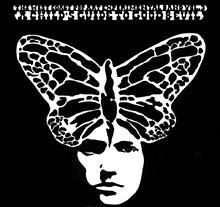
By 1968 the West Coast Pop Art Experimental Band were poised to release their fourth album - but their last for Reprise. Thus far, in terms of record sales at least, they had conspicuously failed to set the world alight - or even the small corner they call Los Angeles. Yet in many ways 'Volume III - A Child's Guide To Good And Evil' (RS 6298) was the group's most extraordinary achievement.
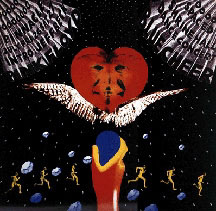
The article pointed to the album's closing track, 'Anniversary Of World War III', as the perfect example of Bob's economy with words - three minutes of total silence. Whether one views the comparisons with Dylan and Donovan as justified - or merely as evidence of Markley's delusions of grandeur - the album was certainly the band's most complex offering to date. As its title suggested, the work was a fusion of innocence and malice, the subject matter perfectly reflected in John Van Hamersveld's striking cover art work.
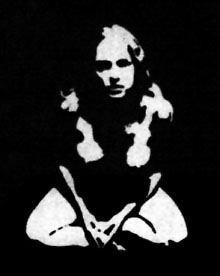
John recalls his work on 'A Child's Guide': "Bob Markley wanted a photograph of the band on the back so I took them up onto a hillside near Burbank and photographed them in colour with a Hasselblad camera and a wide angle lens. For the front cover I used the face from a photograph of Stevie, an artist friend who would pose nude for me. I combined my drawings and letterforms in black and white to create a stark contrast in the record racks. Black and white was also an issue in terms of dark and light karma. The butterfly's wings are a psychological symbol for reading in to the mind, like an ink blot test by a psychologist, but as art. In this image, the head is thinking of the butterfly image - freedom from the karma in the well of darkness." It was surely one of the most powerful and iconic cover illustrations of its era.
|
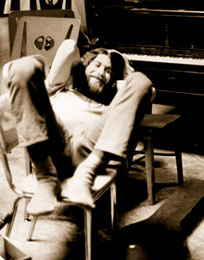


Blue Cheer
Design by Frank OberlŠnder for River Of Many Streams in association with John Van Hamersveld.
© Frank OberlŠnder & John Van Hamersveld. All Rights Reserved.